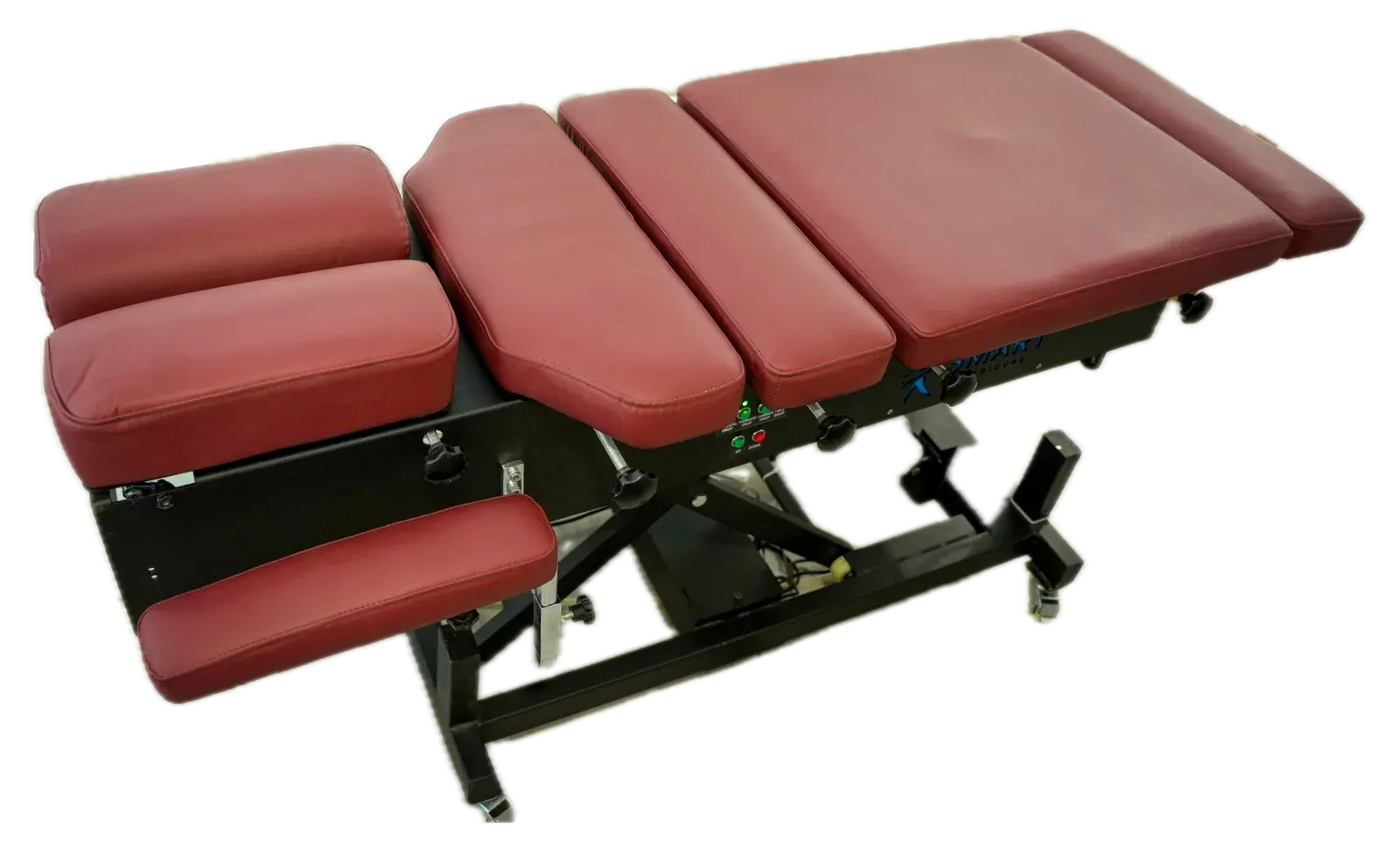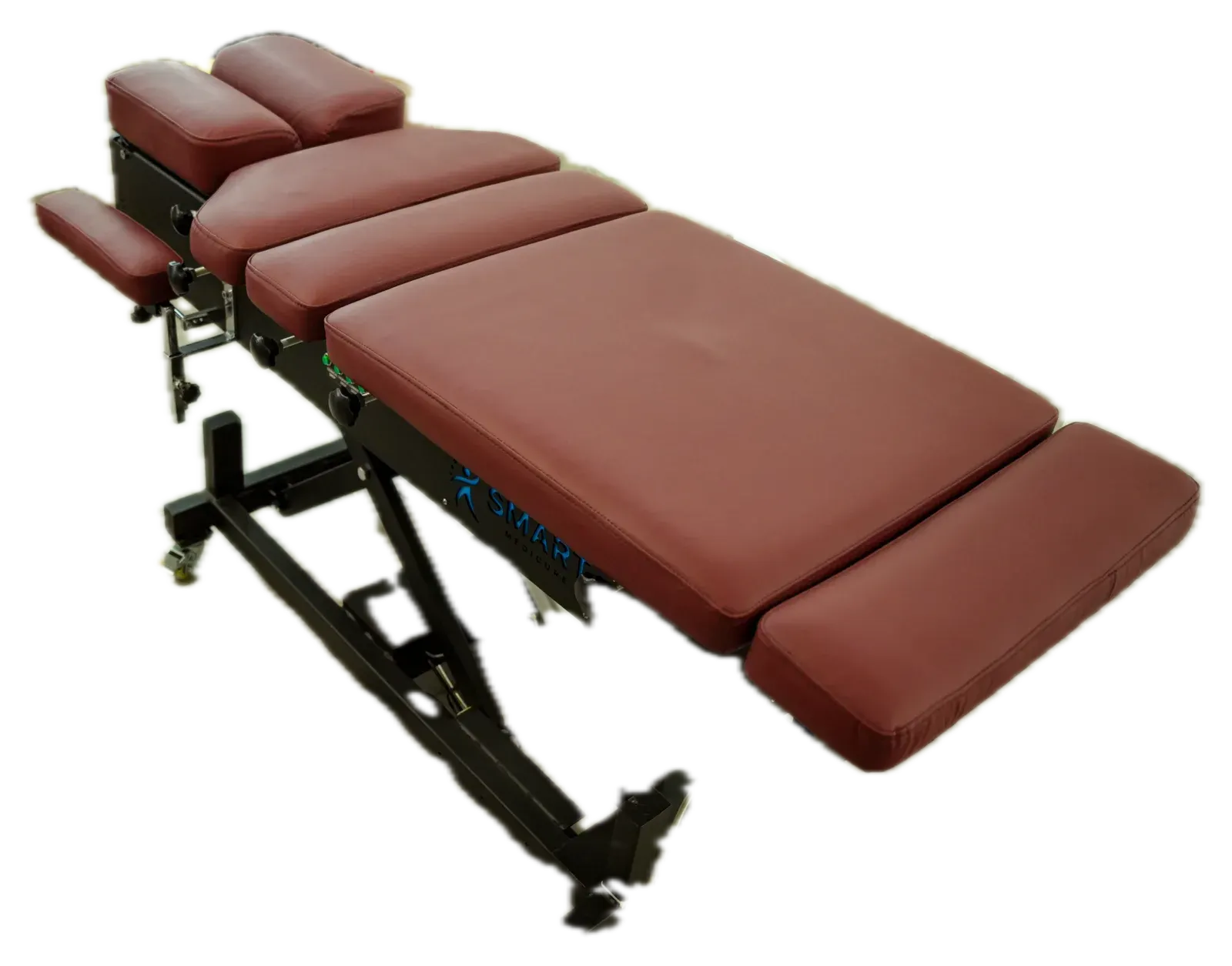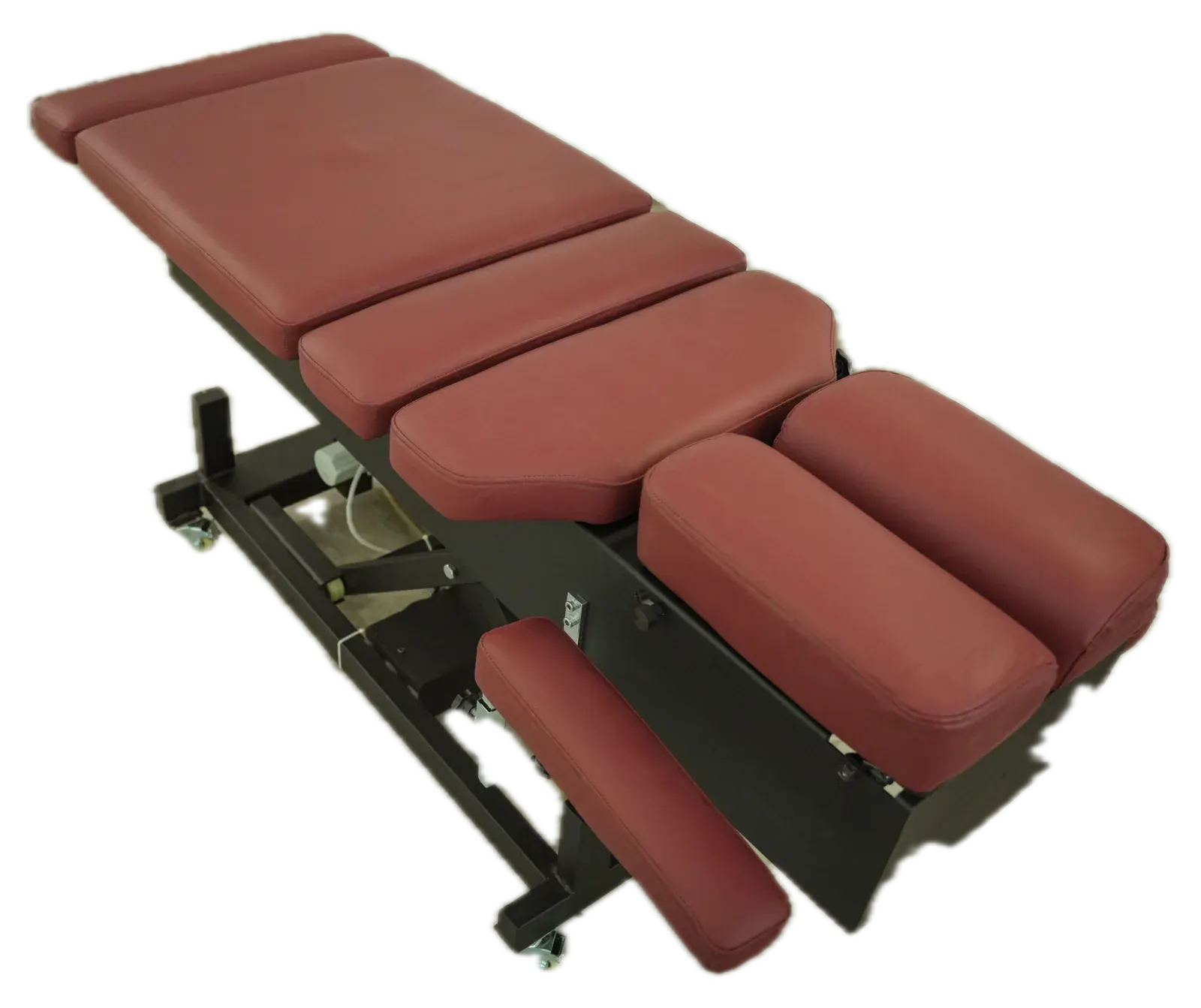
A drop table lets a section of the table fall a short distance when the practitioner delivers a thrust. The section is "set" under tension, the thrust releases it, and the drop takes some of the work out of the adjustment. Almost every other decision about the table follows from how you use those drops.
Air drops or manual drops
Manual drops are reset by a handle after each thrust, and the tension of each drop is set from the right side of the table. They are quiet, need no power for the drops themselves, and a ball-bearing mechanism keeps them smooth and consistent with little upkeep.
Air drops are armed with compressed air. On our Automatic Chiropractic Air Drop Table you can arm a single drop with its switch, several at once, or re-arm the last set with the foot pedal. The compressor is included. This saves time and effort when you give many drop adjustments a day.
Questions to ask yourself:
How many drop adjustments do you give on a typical day?
Do other practitioners, with different preferences, use the same table?
Is there a quiet place near the table for a small compressor?
Fixed height or height-adjustable
A fixed-height table is made to the working height you specify when ordering, so it should suit the practitioner who will use it most. Our Fixed Height Manual Drop Table is built this way.
A height-adjustable table moves with a foot pedal. Our drop tables adjust from 12 to 32 inches (roughly 305 to 815 mm). The low position lets older or less mobile patients sit and then lie down without climbing; the high position lets a tall practitioner work without bending. If more than one person adjusts on the table, height adjustment is usually worth it. See the Height Adjustable Manual Drop Table.
Which drop sections you need
Four sections is the usual configuration:
Drop | Where it sits | Typical use |
|---|---|---|
Cervical | Headpiece | Neck adjustments; on our air table the headpiece has a double drop |
Thoracic | Chest section | Mid-back adjustments |
Lumbar | Low-back section | Lumbar adjustments |
Pelvic | Pelvic section | Sacro-iliac and pelvic work |
Check that tension can be set independently for each drop and from one side of the table, so you do not walk round the patient between adjustments. If you also treat extremities or work away from the clinic, portable drops add a drop to a treatment table or couch.
Load rating, size and frame
Load rating. Ask for a figure, not "heavy duty". Our tables are rated to 200 kg.
Size. Our drop tables are 6 ft by 2 ft (about 1830 by 610 mm). Allow working space on both sides and measure door widths for delivery.
Frame. Powder-coated mild steel resists chipping and cleaning chemicals better than paint.
Castors. Lockable wheels let you move the table for cleaning and hold it firmly during treatment.
Upholstery and comfort
We use double-layer foam under Rexine upholstery, which wipes clean between patients and comes in a range of colours. Ask any maker how the upholstery is fixed and whether cushions can be replaced on their own, because covers wear long before frames do.
Before you order: a checklist
Drop mechanism: air or manual, and whether a compressor is included.
Height: fixed (to what height?) or adjustable (what range?).
Drop sections and tension controls.
Load rating in kilograms.
Dimensions, and whether the table fits your room and doorways.
Upholstery material, colour and replacement cushions.
Warranty terms and who supports you after the warranty. Ours is one year on manufacturing defects plus lifetime telephone support.
Delivery time. Ours is 15 to 30 days for tables.
The maker's quality system. See what ISO 13485 means for buyers.
If you are deciding between two or three of our tables, the comparison page puts their specifications side by side.
About the author
Dr Amit, Training and Support, Smart Medicure
Dr Amit leads training and support at Smart Medicure, helping clinics set up and use their tables and decompression systems.
Topics: chiropractic, drop tables, buying guide