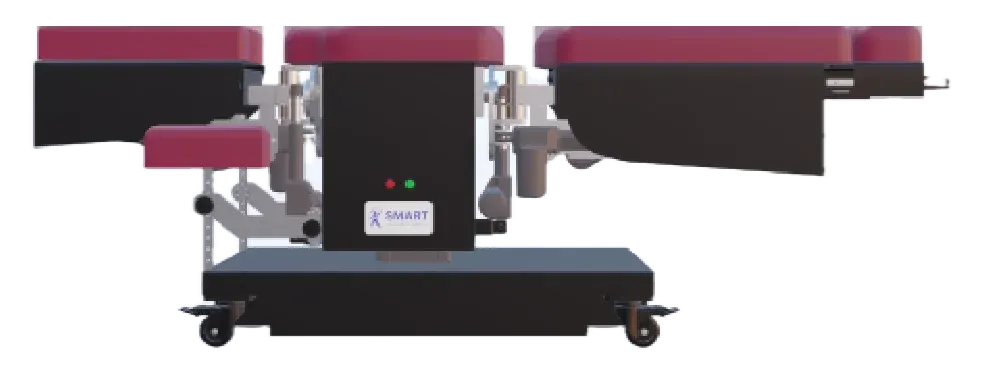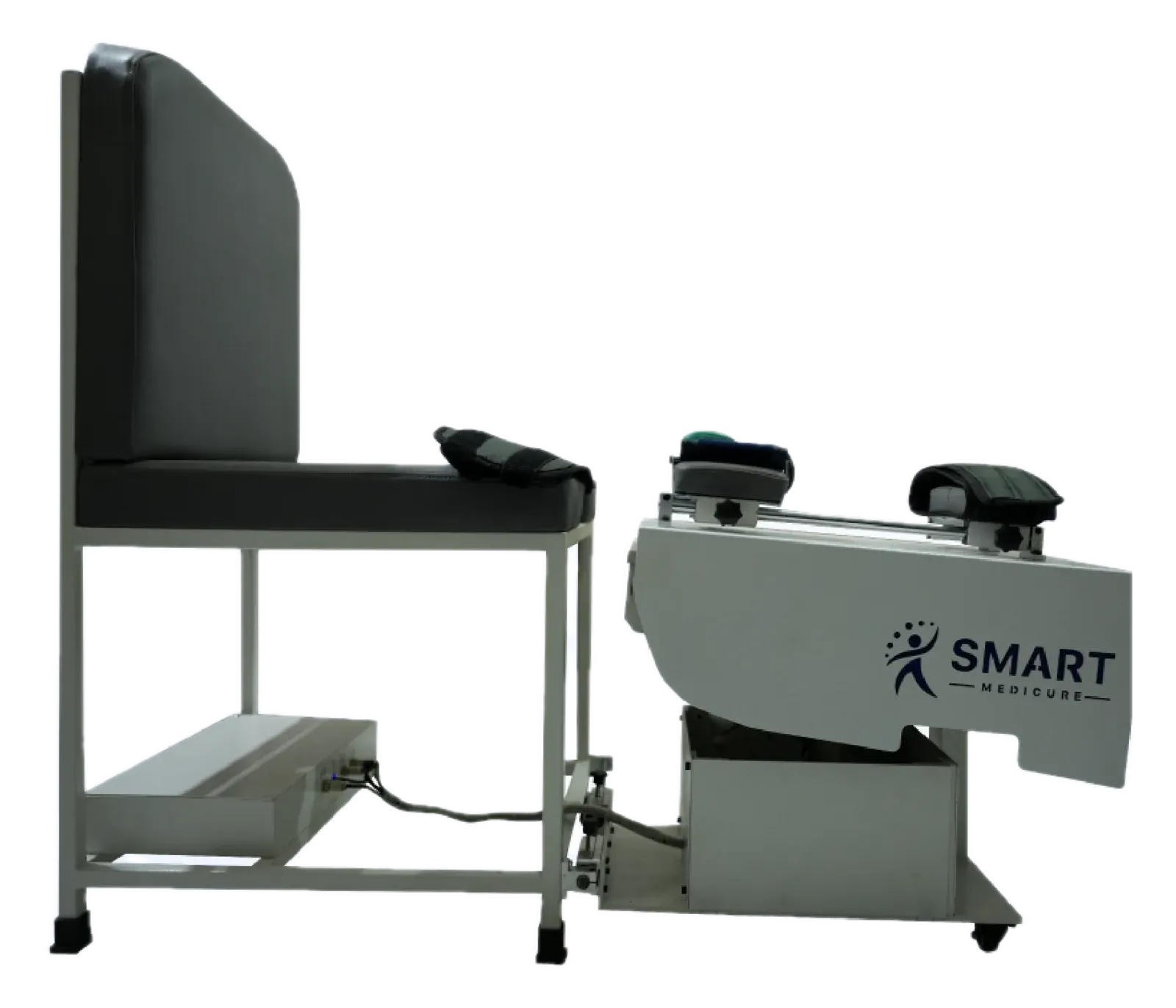
Both kinds of table apply a controlled pull along the spine. The difference is who, or what, controls the movements around that pull, and how much of the session the practitioner has to supervise directly.
What each system does
Manual (practitioner-positioned) decompression. On our Manual Spinal Decompression Table, an electric actuator provides the traction. The practitioner positions the patient and sets lateral flexion and rotation by hand, adjusting as the session goes. Height adjusts automatically from 20 to 42 inches. It treats both the lumbar and cervical regions.
Robotic decompression. On our Automatic Robotic Spinal Flexion Decompression Table, decompression, oscillation, flexion, lateral flexion and axial rotation are all motor-driven for the lumbar and cervical spine. The practitioner chooses and adjusts a program on an integrated touch-screen PLC/HMI, and live charts show what the table is doing. A program runs the same way each time it is used.
Side by side
Feature | Manual decompression table | Robotic decompression table |
|---|---|---|
Traction | Electric actuator | Motor-driven, programmed |
Flexion, lateral flexion, rotation | Set by hand by the practitioner | Programmed, including axial rotation |
Control | Practitioner at the table | Touch-screen PLC/HMI with live charts |
Repeatability between visits | Depends on the practitioner | The same program runs the same way |
Practitioner time per session | Present throughout | Sets up, then supervises |
Training | Set-up support by video call | Operator training by video call; on-site on request |
Height range | 20–42 in | 22–32 in (hydraulic) |
Load rating | 200 kg | 200 kg |
Questions that decide it
How many sessions a day? If decompression is an occasional part of your treatment plans, a manual table is often enough. If it is a core service with a full daily schedule, programmed sessions free the practitioner between set-up and review.
Who runs the sessions? A manual table needs a trained clinician at the table for the whole session. On a robotic system the clinician sets the program and supervises while it runs.
How consistent must sessions be? On the robotic table the program, not the practitioner's hands, sets the movements, and the live charts on the HMI show each session as it runs. That consistency helps when a patient comes for a course of sessions.
Which regions do you treat? Both of our tables cover the lumbar and cervical spine. For the knee there is a separate robotic knee decompression machine (SMK-90) with six preset programs.
Space and power. Both tables are 6 ft by 2 ft. Allow room around the table for the practitioner and for patients to get on and off, and a standard power point nearby. Tell us your country when you ask for a quote so we can confirm the voltage.
Moving from one to the other
One path is to start with a manual table and add a robotic one when the decompression schedule fills; the manual table then stays in use for patients who need hands-on positioning. If you are planning that path, tell us when you ask for a quote and we will suggest a configuration for both stages.
What to ask any maker
Which movements are powered, and which are set by hand?
How is a session controlled and displayed, and can programs be adjusted per patient?
What safety features are there? Ours include an emergency stop and protection against high and low voltage.
What training is included, and who supports you afterwards? We train operators on programs, patient set-up and safety by video call, with lifetime telephone support; on-site training is available on request, charged at the trainer's daily rate plus travel allowance.
What is the load rating and height range?
Is the maker's quality system certified? See what ISO 13485 means for buyers.
To work out how quickly either table could pay for itself at your session fee, use the calculator in how clinics work out the payback on a decompression table.
About the author
Dr Amit, Training and Support, Smart Medicure
Dr Amit leads training and support at Smart Medicure, helping clinics set up and use their tables and decompression systems.
Topics: spinal decompression, buying guide